
Which one is better, being a specialist or generalist? Well, maybe not any of them. Instead, the better choice is being a versatilist. There is a good note about it in a Gartner study quoted in The World is Flat by Thomas Friedman:
Specialists generally have deep skills and narrow scope, giving them expertise that is recognized by peers but seldom valued outside their immediate domain.
Generalists have broad scope and shallow skills, enabling them to respond or act reasonably quickly but often without gaining or demonstrating the confidence of their partners or customers.
Versatilists, in contrast, apply depth of skill to a progressively widening scope of situations and experiences, gaining new competencies, building relationships, and assuming new roles.
Friedman added that “versatilists are capable not only of constantly adapting but also of constantly learning and growing” and that they are comparable to “Swiss Army knives” rather than “specialty tools”.
I totally agree with it. This is a fast-changing world, so the best people are those who can quickly adapt and take opportunities of the new waves. From this, we can see that there are actually two things versatilists do:
- They recognize that a new wave is coming before anybody else, and
- They adapt themselves quickly to take the opportunities of the new wave.
To do point 1, we need something I call anticipation engine, while to do point 2 we need something I call learning engine. So, if we are to be a versatilist, we need to focus on building these two things: “anticipation engine” and “learning engine”.
Somehow, it matches very well with what I believe to be the most important skill: the ability to choose what to learn and to learn them quickly.
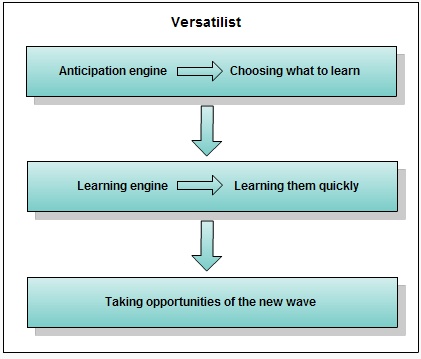
Anticipation engine deals with the first part of the skill, that is “the ability to choose what to learn”, while learning engine deals with the second part, that is “to learn them quickly”. If we have a good anticipation engine, we will know what the next wave is and where the opportunities will be. From there, we can correctly choose what to learn. Then, after choosing what to learn, the learning engine will help us to learn them quickly so that we can adapt and take opportunities of the new wave.
The graph below summarizes what I believe to be the “ingredients” of versatilists:
Note:
Of course, versatilists need more than just anticipation engine and learning engine to succeed. To execute the third step in the graph – taking opportunities of the new wave – they also need other skills such as communication skill or conflict resolution. But these are not what make versatilists different from the rest; specialists and generalists also possess these skills. What make versatilists different are their anticipation and learning engine.



Great post, Donald. This really struck a chord with me. My philosophy is the focus intently on one thing at a time, but to move from thing to thing every so often. Keep up the good work.
Thanks, Brian. That’s a good idea, to focus intently on one thing but then move often. I think many versatilists do that.
Thanks for introducing me to this concept Donald! I think we are all familiar with it but it just needed a name. I think a lot of us in Personal Development circles are versatilists because of the strong emphasis we place on growth. Thanks
Mark McManus
Yes Mark, I agree that many people already do this because of the fast-changing world. Having a name can help us consciously develop it even further. Thanks for stopping by!
This is a novel concept for me. I got to try it out.
[…] In this fast-changing world, it is important to be versatilists. Unfortunately, it is far too easy to get off the versatilist track. So I guess we need some sort of checklist to help us on track. […]
[…] Several weeks ago, I wrote a list of competencies that can help you become a versatilist. Here is one of them: […]
[…] I use the term “anticipation engine” for this ability to anticipate the future. This is an important part of being a versatilist (see Be a Winner by Being a Versatilist: What, Why and How). But how do we build the anticipation engine? […]
[…] You should have deep knowledge in one or two fields which become your specialization (the head of the tail). These are the fields for which you are known to the outside world. On the other side, you should know a little about a lot of other fields, even those unrelated to your specialization (the long tail). Knowing these other fields helps you understand what options are available and quickly recognize emerging trends. You can then move fast to ride the waves of those emerging trends. This way you will become a versatilist. […]
Good post. You make some great points that most people
do not fully understand.
“Of course, versatilists need more than just anticipation engine and learning engine to succeed. To execute the third step in the graph – taking opportunities of the new wave – they also need other skills such as communication skill or conflict resolution.”
I like how you explained that. Very helpful. Thanks.
You’re welcome, Chiz!
Hi.
thanks for the great post!
I asked one of my professors from the University what should I put as my future goals be a specialist or generalist and she replied to me:
it depends on your personal goals, if you want to work a non-managerial positions you could be specialist, on the other hand if you want to really succeed you have to go deeper and wider, i.e. Versatilist.
Take care,
Slavi
Slavi,
You’re welcome, I’m glad you like it. I agree with your professor. Being specialist is good, but being versatilist is even better.
I think that the problem of being “deeper and wider” as Slavi’s professors said, is the time. It looks like the Versalist is a combination of a Specialist with a Generalist. It’s a person who have a relative deep technical knowledge in some areas with the skill to connect it with fields that borders with them. As we all know it’s not a easy task to build a deep knowledge, it may take years before you can use a skill efficiently. I wonder how the Versalist will deal with this apparent overload (of being deeper and wider at the same time). Maybe this is the biggest challenge: How to be the right versalist at the right time…
Helio,
I think versatilists are not deeper and wider at the same time. Instead, they go deep on one subject at a time. Their strength lies in their ability to pick the right subject and quickly learn it.
[…] Be a Winner by Being a Versatilist: What, Why and How […]
[…] Be a Winner by Being a Versatilist: What, Why and How […]
[…] In this kind of world, just being a generalist or specialist is not enough. You need to become a versatilist. A versatilist is a person who can quickly adapt to new situations and take advantage of them. I […]
[…] One important thing to remember is you shouldn’t just upgrade your current skills. What if your field of expertise became irrelevant in the near future? What if the world no longer needed it? So, instead of just improving your current skills, open your eyes for new skills to learn. Is there a skill that could be in high demand a few years from now? Is there a skill that becomes increasingly necessary? Don’t just be a specialist. Be a versatilist. […]
I think you can cast the role of the “Versatilist” within a technical area, such as IT. The IT versatilist may be more capable than a specialist in solving problems when that person understands the relationships between the functional parts of the broader system and has knowledge that spans the “edges” of typical specialties (e.g. networking, application support, server virtualization, printing, mainframe services, etc).
In my experience, a versatilist is in a good position to acquire “depth” from working with specialists, since the versatilist has a broad scaffold of knowledge to organize and understand the deeper knowledge in many areas. Building “deeper” over time empowers the versatilist to better innovate and solve problems across the whole system.